Abstract
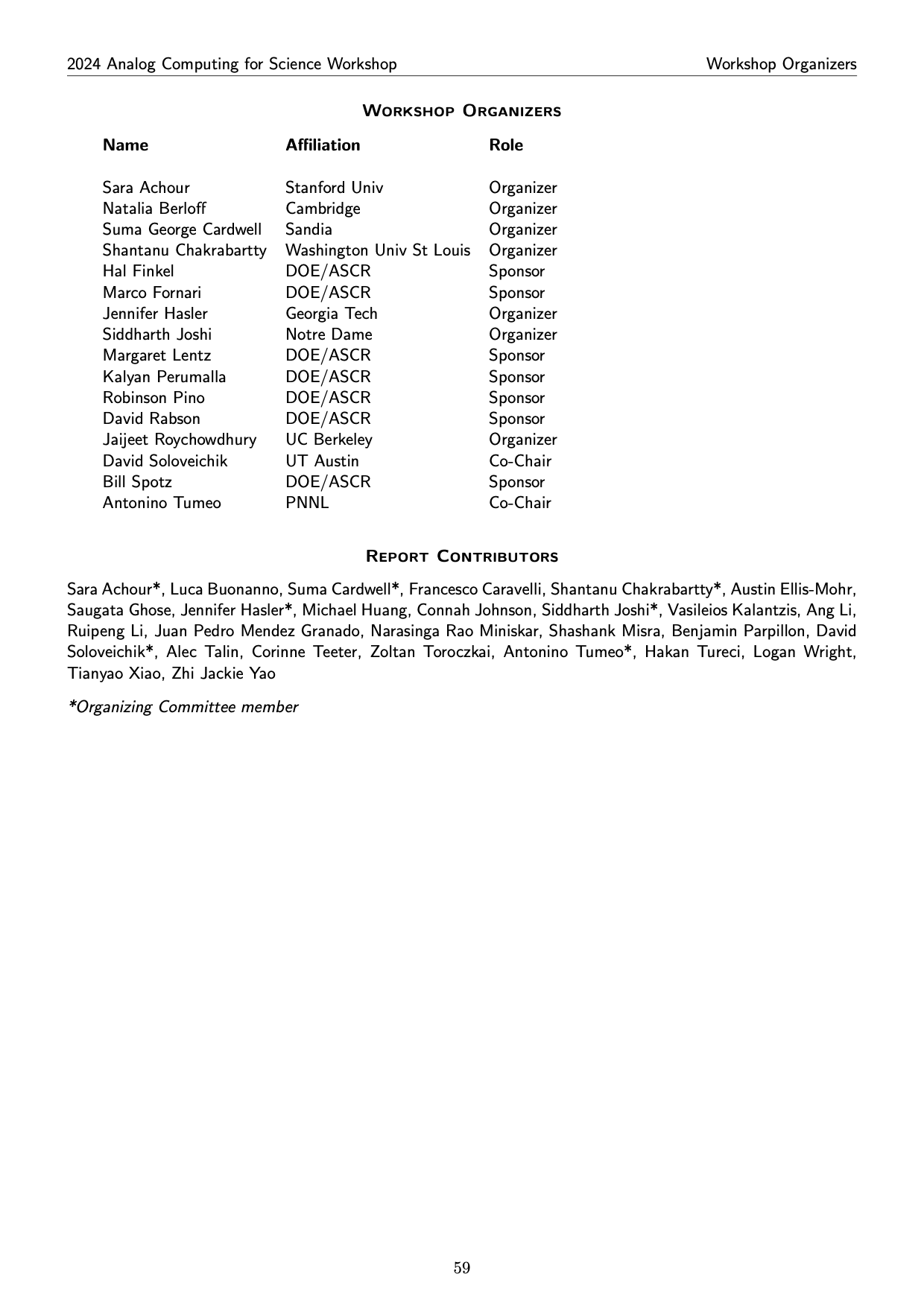
In September 2024, the US Department of Energy (DOE)’s Advanced Scientific Computing Research (ASCR) program convened a Workshop on Analog Computing for Science to address the critical research challenges and opportunities in this field, bringing together experts in applied mathematics, computer science, device physics, and applications domains from academia, government, and industry. The participants identified six interconnected priority research directions (PRDs): (1) developing a rigorous mathematical foundation for analog computation, (2) designing high-performance analog computing architectures, (3) establishing reliable device primitives, (4) enabling edge computing for real-time analysis, (5) exploring natural computing substrates, and (6) creating co-design methodologies that integrate software and hardware.
Agency Report
- Original Report Listing at OSTI
- Original Report PDF at OSTI
- Cached Report PDF local copy
Agency Brochure
- Brochure PDF at OSTI
Agency Program Documents
- ASCR Program Documents Listing
Selected Images
Selected Extracts
Conventional digital computing faces fundamental physical limits: large scale computing systems already consume tens of Megawatts of power, Dennard scaling has ended, and data movement costs dominate application performance. Next generation experimental facilities generate data at rates that overwhelm conventional processing and demand real-time analysis at the source. Analog computing, which exploits the continuous dynamics of physical systems to perform computation, promises a transformative path toward orders-of-magnitude gains in energy efficiency and time-to-solution for scientific workloads.
The workshop’s findings also identified several cross-cutting challenges underpinning all six PRDs, including a mathematical theory of continuous computation under noise, programming abstractions and compiler toolchains, and community benchmarking infrastructure, emphasizing the needs for a coordinated, multi-faceted effort to enable rapid progress in the area. The research directions outlined in the workshop report aim to guide the development of energy-efficient analog computing technologies that can support future scientific discoveries and address the growing energy demands of scientific computing and artificial intelligence.
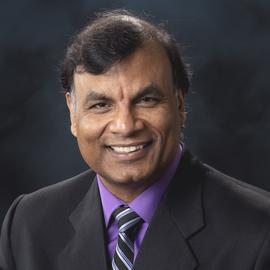
Kalyan Perumalla
Kalyan Perumalla is a computer scientist focused on research in supercomputing, quantum computing, and artificial intelligence, as research staff member, faculty, and program manager with the U.S. government, national labs, and universities. As a Federal Program Manager in Advanced Scientific Computing Research at the U.S. Dept. of Energy, Office of Science, He managed a $100-million R&D portfolio covering AI, HPC, Quantum, SciDAC, and Basic Computer Science. In his 25-year R&D leadership experience, he previously led advanced R&D as Distinguished Research Staff Member at the Oak Ridge National Laboratory (ORNL) developing scalable software and applications on the world’s largest supercomputers for 17 years, including as a line manager and a founding group leader. He has held senior faculty and adjunct appointments at UTK, GT, and UNL, and was an IAS Fellow at Durham University.